

Behind the scenes of getting to a tech transfer agreement with your university (3/4)
Getting ready for the conversation: understanding structures and incentives at play

This is part of a four-part series: The first post is about the main elements of what is called a tech transfer agreement, offers concrete examples and includes sources for reference values and terms. Part two discusses essential questions to keep in mind when negotiating the exact terms. In a third post today, we will take a closer look at the underlying incentives and organizational structures at both universities and startups - to help you understand each other better as negotiation partners. In a final post this will help to look at some points of friction that might arise due to the different incentives and structures and how to resolve them.
To aid the conversation between university and you as a potential founder even more, let’s look at the different players involved in the negotiation and their incentives and underlying structures.
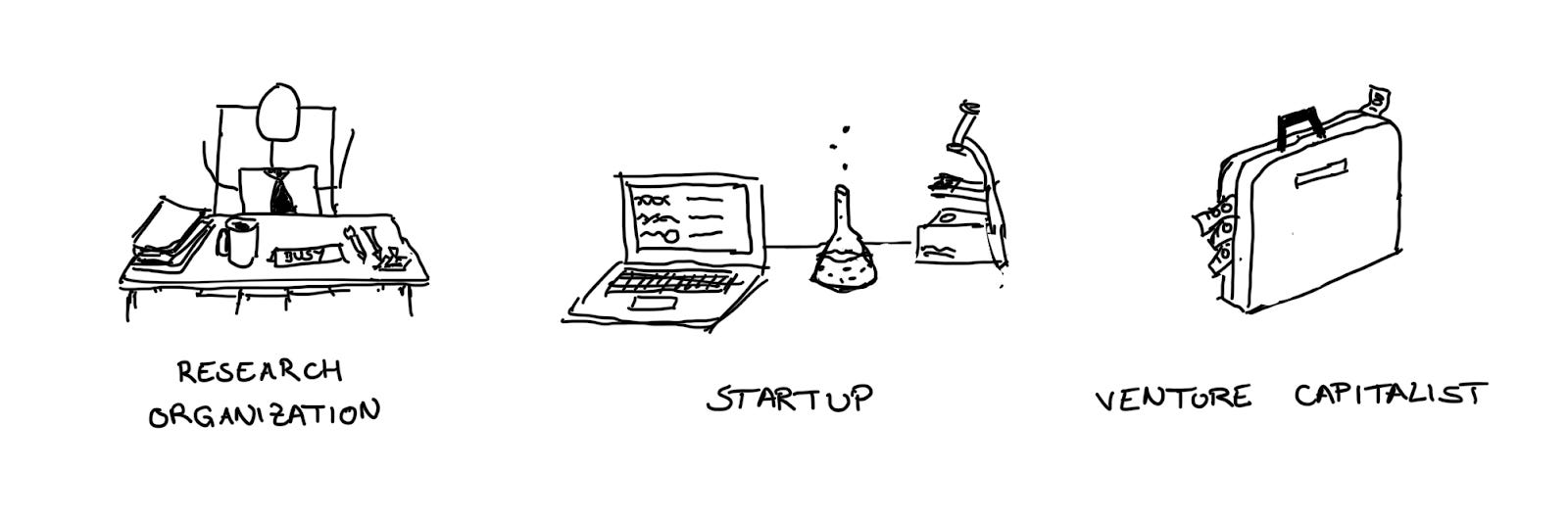
1. The Research Organization
Setup:
First of all: this is not one single player. On the side of the research organization there are actually most likely several players involved and it is good to understand their different roles:
The professor/PI/group leader, in whose group or department the research to be transferred was done. Unless the department head is joining the company, there will most likely be someone ‘higher up’ who might feel that he or she has direct stakes in the developed technology.
Possibly an institute and its head/director, especially at larger research institutions like Fraunhofer Society or Max Planck Society in Germany the organization has individual institutes with individual interests that might not always fully align with the ‘central’ TTO.
The tech transfer office (TTO) or someone representing the university/research organization and negotiating agreements on their behalf. (This might include someone from legal departments or even an external agency handling patent transfer for the university)
Most institutions rarely do this. No matter which of the involved players (PI, institute director, TTO,…) you look at: across the board there are very few that do this regularly (in those cases it is then either individual professors at universities or larger universities and research organizations) and most that have little to no experience with these processes. So don’t expect them to be experts. A survey of 565 European tech transfer offices sees 45% of them in 2020 not engage in a single spinoff creation process per year (looking at more data it remains about 50% across the years), i.e. one out of two tech transfer offices does not negotiate a single IP transfer/license to a startup in a given year. On the other hand, there are a couple that do so very frequently. If you are at one of these places, you probably know and as mentioned earlier they might even have standard processes in place. For everyone else: it is very likely that your university hasn’t done this much more often than you have. So come prepared with templates and examples. (see my first post linking to some examples)
With absence of experience will also come absence of existing structures needed for certain types of tech transfer, e.g. the ability to hold equity.
What is important to the research organization (& its individual players):
They are the ones that have incurred costs so far. Both on the R&D (although that might have directly come via research grants etc.) and from the university budget itself on IP - filing and holding patents. For many institutions, covering these costs is a primary incentive.
The costs that have incurred were most likely predominantly paid for by public money, which means that there are certain boundary conditions of what the university/research organization is allowed to do with the technology. For example, something that was developed by taxpayer money cannot be given away for free to an external company, this would in effect be a subsidy to the company. So the organization is by law forced to find the ‘fair market value’ of the technology so that it does not favor any player in the market.
The research organization will most likely want to continue to be able to do research in the field of the IP that you are transferring/licensing. This might be easier without a full transfer or including certain rights back to the research organization.
The biggest caveat: the overarching incentive structure. Tech transfer is rarely an explicit goal of any research organization that anyone is held accountable for (unfortunately so!) - especially not in actual quantitative numbers of e.g. startups created or patents licensed. Instead academia thrives on publications as a go-to-currency, followed quickly by amount of grant money procured or at more applied research organizations the utmost incentive is acquisition of industry contract research projects. As long as these incentives are structurally embedded into organizations and academia as a whole, any time or budget spent on tech transfer will always be a nice-to-have. On the contrary, a lot of time is spent on administrative work like grant applications. In my view this is dramatic and not at all how it should be. I think publicly funded research should come with the responsibility to return the results to society (via whatever means - startups being one of them), but the current systems’ incentives are certainly stacked against this.
2. Startup, or initially: you, the scientists/founders of the company
Setup:
A handful of people willing to leave their jobs and to try something new that they have likely little to no experience with.
It’s a risky endeavor - even if the starting point is great technology, there are ample risks to the success of your venture: from misalignment with your cofounder, to not finding enough paying customers, to insurmountable engineering challenges when scaling up the product,...
Likely, success is quite a bit in the future. This can easily be a 5-15 year journey depending on your product and market.
What is important to the startup or founders:
The startup has limited cash resources. At the point of incorporation there are likely no sales and even if you have investors lined up, the money you bring in will be limited to get you to the next milestone but does not allow for ample spending.
With little cash comes little time. A startup can simply not afford to be slow, either for risk of competition overtaking them or for risk of money running out before the next relevant milestone is reached.
This being a long journey, with scarce cash and other resources, you might need other ways than high salaries to incentivize people to work with you for this extended journey. Typically this happens by giving them (virtual) shares to allow for participation in the potential success of the venture. You want to make sure that your setup allows for this future growth.
3. Venture Capital firms
They are (probably) not a direct participant in the tech transfer negotiation but often times the first bigger shareholder outside of your founder group and thus also good to understand.
Setup:
VC funds come in many different forms and shapes, with different focus areas and accordingly very different experience with IP-based ventures. Make sure you weigh their input against their experience. Having a research organization as a shareholder or involved in the incorporation of a company might be new to some VCs too, so ideally find partners that have done this before.
One of their tasks will be bringing in future financing partners and thus they can bring in understanding what’s attractive or acceptable to others
What is important to a VC:
They want to reduce their investment risk and a firm access to strong IP can do just that.
Similar as with the startup, they are concerned with the long journey ahead and how to incentivise parties that will be needed to make this a successful journey.
This should help give a broader understanding of potential misalignment in tech transfer negotiations. In a final post, let’s take a look at where these incentives and setups lead to a couple of concrete points of friction and arguments and how to deal with them.
Share this with anyone who is in a tech transfer process right now and look out for the future posts on this topic!
If you think your science is pretty cool but you are not sure yet if you are cut out to be an entrepreneur: let’s talk. E-mail me or join an upcoming 1:1 office hour for scientists.
If you know someone who you think has the potential to be a great scientist-entrepreneur (although they might not realize so yet themselves), reach out to me at scientists@positron.vc.